$3.8 million redevelopment planned at Murray Bridge’s Hume Reserve
The state government, Ngarrindjeri authorities and the local council are collaborating on a plan to revitalise a long-neglected riverfront area.

This story is now free to read. Help Murray Bridge News tell more stories like this by subscribing today.
A long-neglected riverfront reserve in Murray Bridge may soon get a facelift, ending decades of uncertainty about its future.
Hume Reserve – also known by its Ngarrindjeri name, Pomberuk – has been a bare expanse of dirt for more than 20 years, despite being located only a stone’s throw from Murray Bridge’s CBD.
In years gone by it was used as a ski beach; and before that as a campsite for the Ngarrindjeri people, back when segregationist laws pushed them outside the town’s limits.
More recently, though, it has been largely forgotten, caught between the conflicting desires of councillors who wanted it turned into a caravan park and those who believed its significance to the traditional owners was more important.
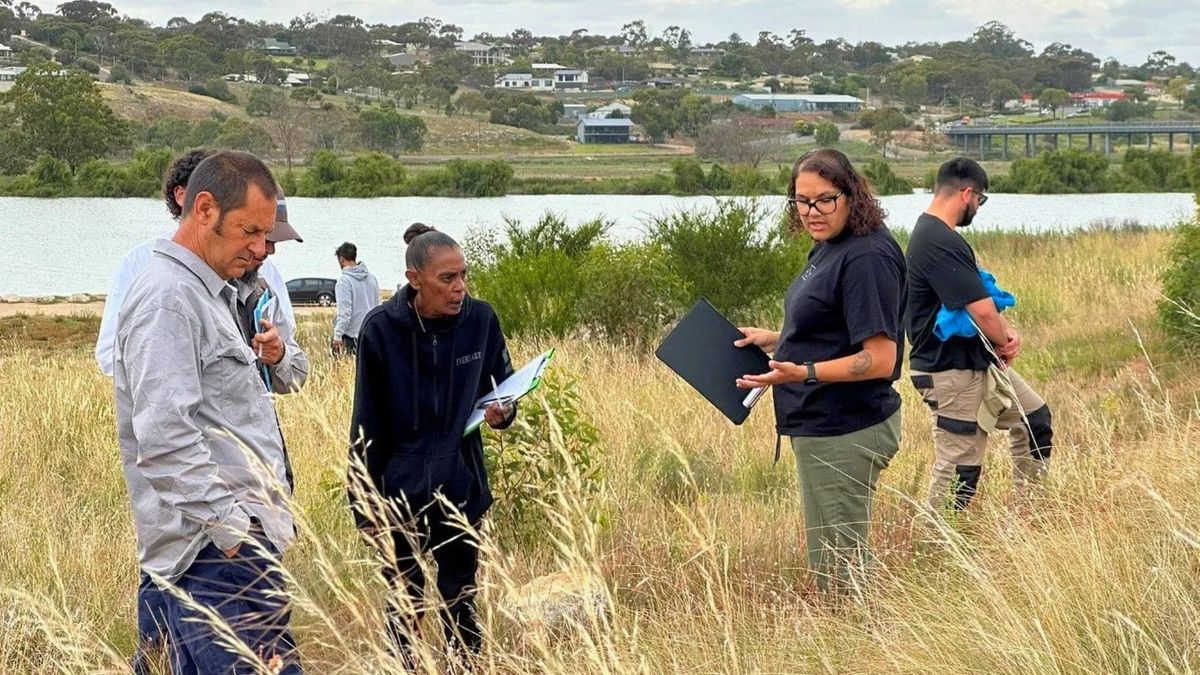
But now Ngarrindjeri authorities, the state Department for Environment and Water and the Murray Bridge council have put together a $3.8 million plan to revitalise the area at last.
The work would be completed in two stages, with the first part contingent on $1.5 million worth of state government funding.
A grassed area, footpaths, picnic tables and shelters would be established along the river bank, and a section of sealed roadway would allow for car parking.
The back part of the reserve would be kept more or less intact until stage two works could be completed down the track.
Those works would connect the neighbouring wetland with the reserve and introduce boardwalks and interpretive signage.

Murray Bridge councillors gave their in-principle support to the final design at a meeting on Monday night.
There was not yet any guarantee that the works would go ahead, they were told, as the council and state government had not yet signed a grant agreement.
But a verbal funding offer had been made, and extra funding was likely to become available in future if the federal government decided to extend the relevant program in its upcoming budget.
The cash will come from a program intended to remove constraints to high flows of water down the river as part of the Murray Darling Basin Plan.
The first stage will be fully funded by the government; the council will only be responsible for maintaining the reserve once the work is complete.

Councillors almost threw a spanner in the works
However, two councillors argued in favour of a different vision when Murray Bridge councillors voted on the idea on Monday night.
Cr John DeMichele suggested that the council ask if it could use the funding for other projects – like Thiele Reserve and the Riverglades wetland – instead.
Several other riverfront locations had been damaged during the 2022-23 River Murray floods, he argued, and they needed a fix more urgently.
Cr Airlie Keen agreed, noting that councillors would need to justify the spending to community members.
“We often have governments make decisions for us,” she said.
“But we can … insist on being leaders in what happens in our community.”
However, the majority view in a 6-2 vote was that the Hume Reserve project should go ahead.
“We must accept graciously the amount that has been offered,” Cr Karen Eckermann said.
“That will put us in a stronger position to ask for more in the future.
“Never look a gift horse in the mouth.”
Councillors Tom Haig and Fred Toogood both suggested the council’s reputation would be damaged, particularly in the Indigenous community, if it turned down the funding.

Riverfront site is important to the Ngarrindjeri people
Since the dawn of time, Pomberuk has been an important meeting place for the Ngarrindjeri people.
According to legend, a granite boulder in the area represents one of the footprints left by Ngurunderi, the hunter who followed Ponde down the river in a creation story.
The traditional owners were there to watch Captain Charles Sturt and his crew, the first foreign visitors to the Murraylands, row their boat down the River Murray on February 8, 1830.
When the pioneering Edwards family first settled in the area, they built their home right above the swamp, as it was the point where cattle could be most easily driven across the river.
Still, the Ngarrindjeri remained encamped on the land until 1943, when its owners, the Hume Pipe Company, demanded that they move.
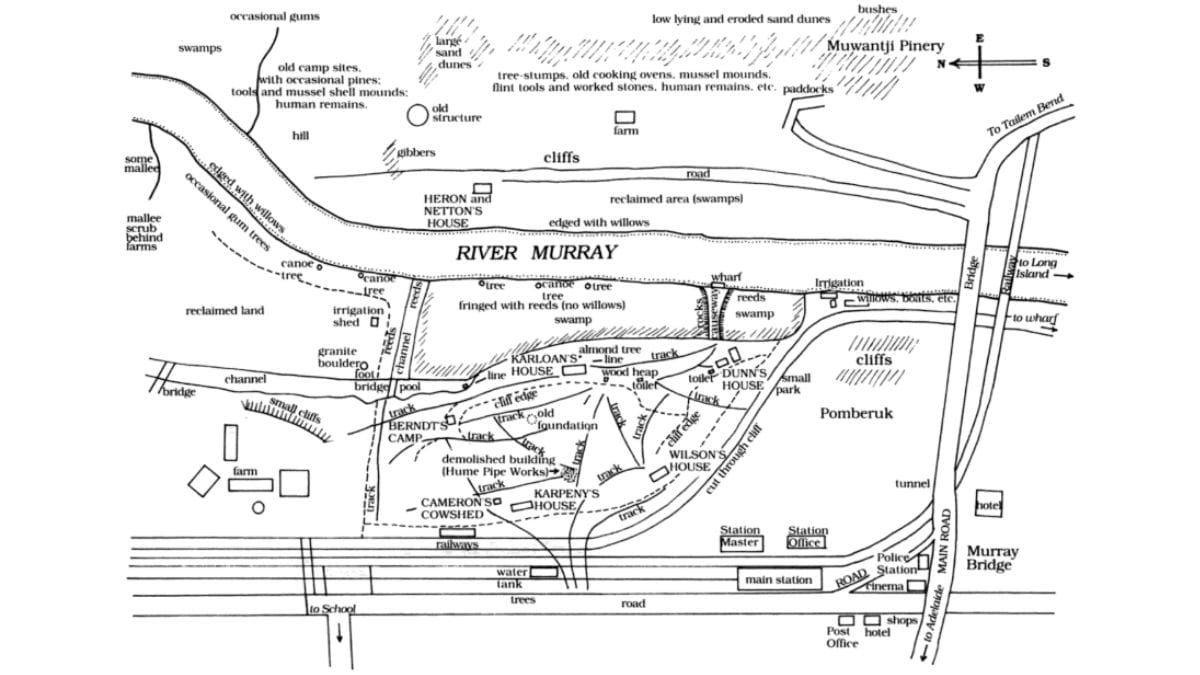
In the face of that demand, anthropologists Ronald and Catherine Berndt – who were studying Ngarrindjeri culture at the time – were able to secure a compromise from the Chief Protector of Aborigines: the camp would not be cleared as long as 78-year-old elder Albert Karloan lived.
But when the Berndts departed on a short trip to Sydney, Chief Protector William Penhall went back on his promise, and ordered the Ngarrindjeri to get out.
Mr Karloan went to Adelaide to lobby the manager of the Hume company, but was turned away.
He returned home to Pomberuk in despair on February 2, 1943, and died the following morning.
The camp was removed soon afterwards.

The Murray Bridge council recognised Hume Reserve’s potential for eco-tourism and a focus on Aboriginal culture at least as long ago as 2007, and reinforced the idea in a more recent water-based recreation plan.
Discussions between the council, the state Department for Environment and Water and representatives of several Ngarrindjeri organisations have been ongoing since 2020; and a working group was given the task of designing a revitalised Pomberuk in 2023.
A final design by Tonkin Consulting and the Ngarrindjeri Aboriginal Corporation was presented to the council in February.
If a funding agreement is signed, the first stage of work at Hume Reserve/Pomberuk will be completed by December.