Family’s tragic history shared on Sorry Day in Murray Bridge
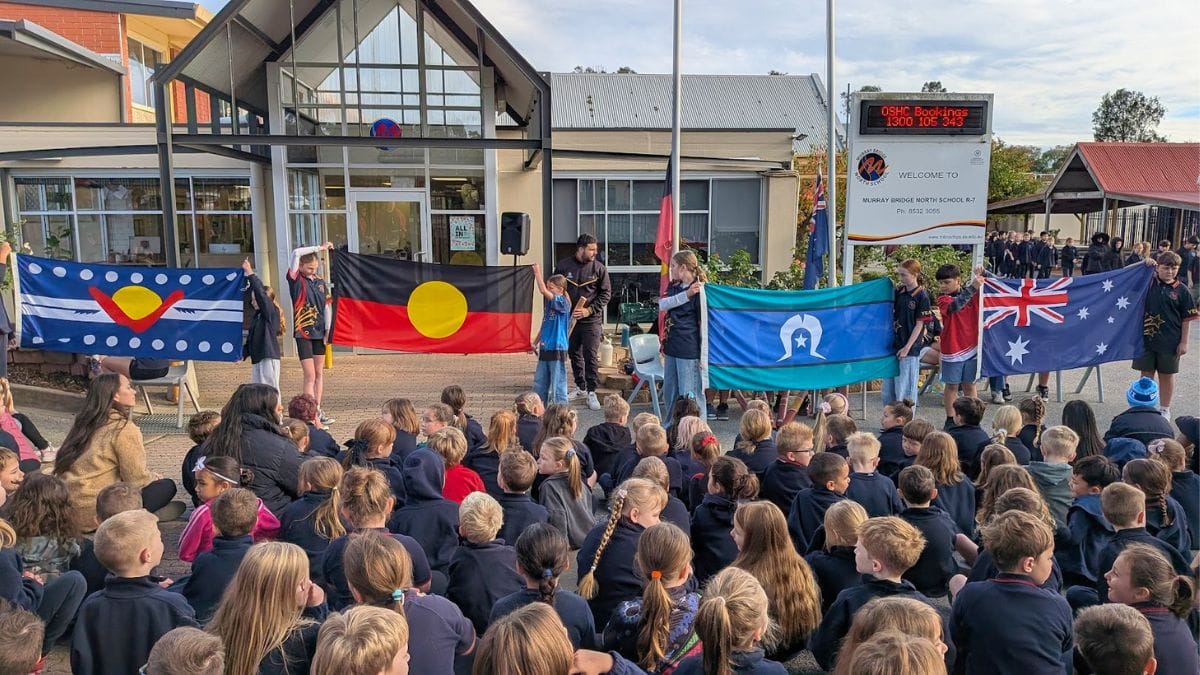
Students at Murray Bridge North School have learned about the Stolen Generation as part of an annual commemoration.


This story is now free to read. Help Murray Bridge News tell more stories like this by subscribing today.
It’s not that long ago that children here in the Murraylands were kidnapped by government agents, without warning or explanation, and separated from their families for decades.
One such story was shared at a local primary school this week for Sorry Day, an annual commemoration of the Stolen Generations.
Ngarrindjeri woman Isobell Koolmatrie spoke about her family, who had lived on the Coorong, at Murray Bridge North School on Wednesday morning.
“My aunty was only the age of eight, and this car pulled up,” she said.
“They told her and her siblings they were going to take them to the circus.
“All four children jumped in the car, so excited, thinking they were going to the circus, as they’d been promised by those people in this big car.”
Instead they were taken away, separated and placed in different homes across South Australia and Victoria.
Ms Koolmatrie’s aunty only got out of the system at the age of 16, and was forced to scrounge a living on the streets of Adelaide.
Another 10 years passed before she was able to reconnect with her family.
It sounded inhumane, but that was the sort of thing governments routinely did as recently as 50 years ago.
“My aunty didn’t get to see her baby brother until his late 20s … and (they) never got to see their parents,” Ms Koolmatrie said.
“The siblings did find each other again, but through a lot of loss, disconnection and sadness.”
That was why Sorry Day was important, visiting Ngarrindjeri Regional Authority representative Annina Tarasenko said.
“It is about truth, it’s about healing, respect and making sure these stories are never forgotten,” she said.
“But … it’s also about strength: our people are strong and we’re resilient.
“Our elders carried knowledge, love and resilience through very difficult times so future generations, including all of you young ones – you po:rlar today – continue to learn, grow and look proudly on who (you) are.”
Today’s schoolchildren could do a lot to heal the wounds of the past just by listening and learning, suggested Stacy Wilson from youth mental health organisation Headspace.
“You can speak with your teachers, visit your school library (or) yarn with elders and community members,” she said.
“You can also play a part by standing against racism and bullying, learning about the traditional owners of the land you live on, respecting Aboriginal cultures and histories, and helping to create spaces where everyone feels safe and valued and included.”
Male students played didgeridoos as part of the morning’s observances, and the Australian and Aboriginal flags were raised to half mast before a morning tea for families and community members.
National Sorry Day – or the National Day of Healing – has been observed in Australia on May 26 each year since 1998, the first anniversary of a landmark government report on the Stolen Generations.
National Reconciliation Week follows from May 27 to June 3, encouraging the strengthening of relationships between Indigenous and non-Indigenous Australians; this year it has the theme “all in for reconciliation”.
- More information: www.reconciliation.org.au.